
Why Business Directories Still Matter in 2026
Every couple of months, someone writes an article about how business directories are dead. They’ve been replaced by social media. Google made them irrelevant. Artificial intelligence will kill them off.
And every year, there are hundreds of small businesses around Canada who continue to get local business from people who found them on those supposedly dying platforms.
The truth is somewhere in between. A lot has changed about directories in the last ten years. The way they create value has evolved. But the role they play, helping a local customer find a local business when that customer is in the market, has remained the same. And arguably, that’s even more important today as the digital marketing environment has become more crowded and more costly.
What Has Actually Changed About Directories
The business directory of 2026 is not the Yellow Pages your parents thumbed through. The shift happened gradually but the result is substantial. Modern directories are dynamic, review-driven platforms that feed directly into search engine algorithms, map results, and voice search responses. They contain structured information that search engines actually use, rather than static pages ignored by the internet.
Google’s local search algorithm has become increasingly smart about judging the credibility of local businesses. One of the most obvious signals is citation consistency, your business’s name, address and phone listed correctly on several trusted directories. A well-maintained listing on Canada Local 101 contributes directly to that signal pool. It tells Google that your business is geographically established, actively operating, and consistently represented across the Canadian web.
This is not a minor technical footnote. It is one of the primary mechanisms through which local businesses earn placement in the map-based results that appear at the top of local searches, results that capture the majority of clicks before any organic listing gets a look.
Canadian Consumers Still Start Their Search the Same Way
Despite every shift in how people use the internet, the buying behaviour that makes directories valuable has remained consistent. Someone needs a service. They search for it. They evaluate the options that appear. They contact one.
That sequence has not been disrupted by social media, and it has not been disrupted by AI search tools either. What has changed is where those results come from and how they are ranked. Directory data feeds into Google Maps, Apple Maps, voice assistants, and AI-generated local recommendations. When someone asks their phone to find the best plumber in Vaughan or the nearest dental clinic in Fredericton, the response is built from structured business data, the same data that directories collect and maintain.
For Canadian businesses, this means that a listing on a Canada-specific directory like Canada Local 101 is not just visible on that platform. It contributes to how your business appears across the entire ecosystem of local search, including tools and interfaces that did not exist five years ago. The directory is the input. The visibility is everywhere.
The Trust Problem That Directories Uniquely Solve
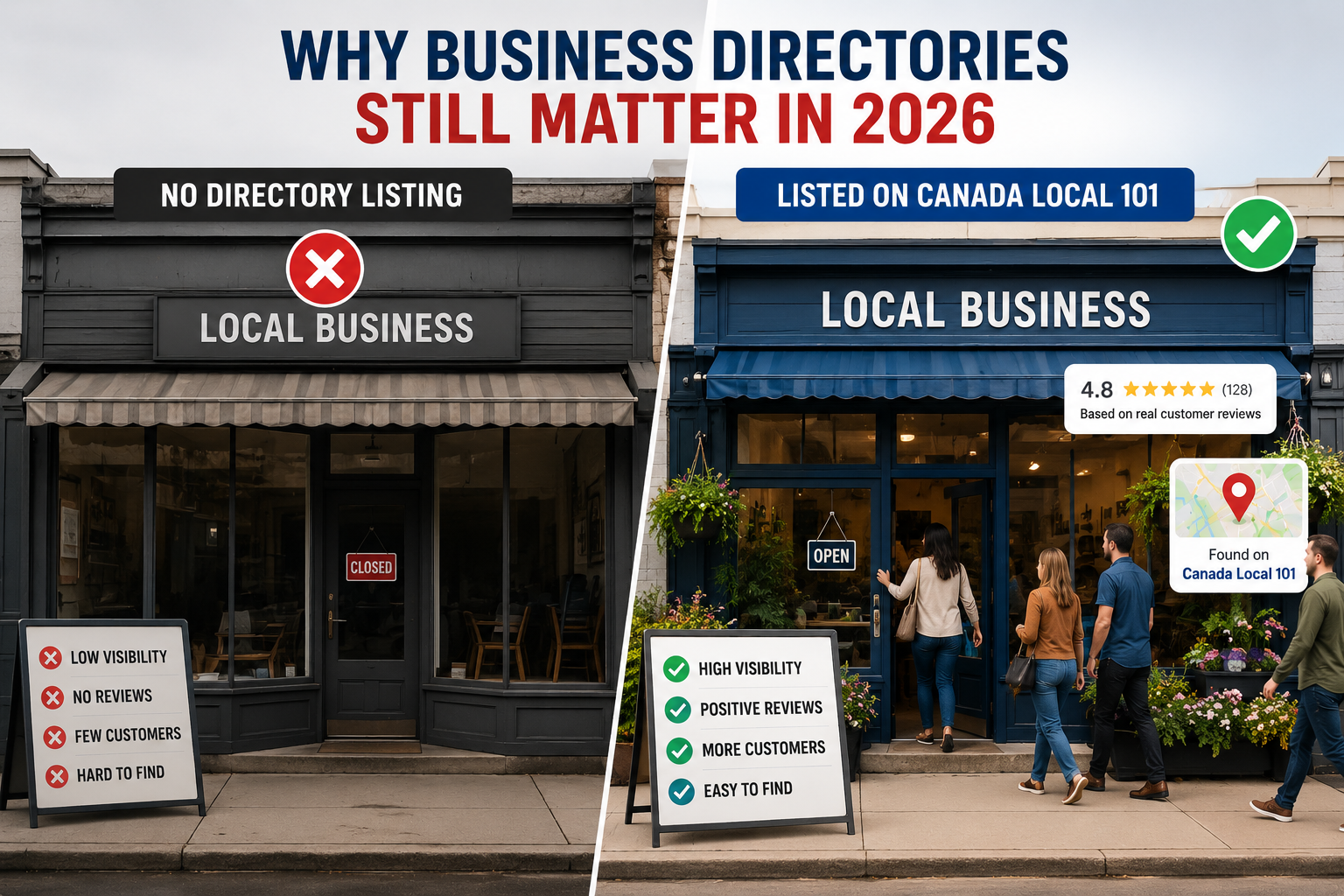
There’s a unique trust problem between a business and a consumer who’s never heard of them. Advertisements make claims but can’t authenticate them. A business website is inherently self-promotional. Neither is supported by an independent confirmation that this business is legitimate, has a track record, and may be worth doing business with.
This is where directories step in – almost uniquely. A filled-out, reviewed and verified profile on Canada Local 101 tells a prospective customer that there is more than one source that supports your business as real and established. The reviews are from actual customers. The rating reflects real experiences. This third-party evidence and peer testimony is the closest to a first-hand recommendation that a stranger can receive online.
In 2016, when Canadian consumers are more wary of advertising and more likely to seek peer advice before making a purchase than they have ever been, this trust function is probably more critical than ever. A business that isn’t listed in the directories is asking customers to take a gamble they are not likely to take when they can click on the reviewed alternative that’s listed right beside them in the search results.
The Cost Argument Has Not Changed Either
Paid search advertising in competitive Canadian markets has gotten expensive. Cost-per-click rates for service-based keywords in cities like Toronto, Calgary, and Vancouver have risen considerably over the past few years as more businesses compete for the same limited ad inventory. The economics of running paid campaigns have shifted in a direction that squeezes smaller businesses out of channels they could afford five years ago.
Directory listings operate on an entirely different cost structure. A well-optimised profile on Canada Local 101 generates visibility, referral traffic, and leads without a cost-per-click attached to every outcome. The investment is made once in building the profile properly, and the returns accumulate over time as reviews grow, engagement increases, and the listing climbs within category searches.
For Canadian small businesses watching their marketing spend carefully, and that is most of them, this matters. The channel that does not require a monthly budget to keep producing results is the channel worth protecting.
Local Search Is Still Genuinely Local
One thing the past few years have confirmed is that local intent in search has not weakened. Canadians searching for services consistently include location signals, either explicitly in their search terms or implicitly through their device’s location data. They want results that are near them, relevant to their province, and connected to their community.
This is where a Canada-specific directory carries an advantage that global platforms cannot replicate. Canada Local 101 is structured around Canadian cities and Canadian service categories. A business in Lethbridge is indexed as a Lethbridge business, not as part of a generalized North American database where geographic precision gets averaged out across millions of listings.
For a business trying to reach customers in a specific Canadian city or region, that local indexing structure is directly relevant to how and where the listing appears. It is the difference between being found by the right people in the right place and being technically listed but practically invisible to the audience that matters.
What This Means for Your Business Right Now
If you own a business in Canada and are trying to decide on where to focus your efforts in 2016, settling the directory question is a straightforward one. The sites that were important three years ago are still important now, and for the same reasons.
The businesses that will be at the top of their local search categories in a few years’ time are the ones creating and managing their presence across the directories now. They are taking ownership of their profiles, completing the listings, building reviews, and ensuring the listings stay up-to-date. That’s not hard to do. It just requires thinking of a directory listing as an asset to be managed and not a goal to be completed.
Canada Local 101 is designed for Canadian businesses that want to connect with Canadian customers. In a local market where trust, proximity and review authenticity matter to whether a consumer calls you or your competitor, a strong presence on a platform built for the Canadian market is not optional. For small Canadian businesses, it is a great place to begin.
Recent Posts

How Canadian Business Citations Improve Local SEO

Canadian Local Marketing Trends for 2026