
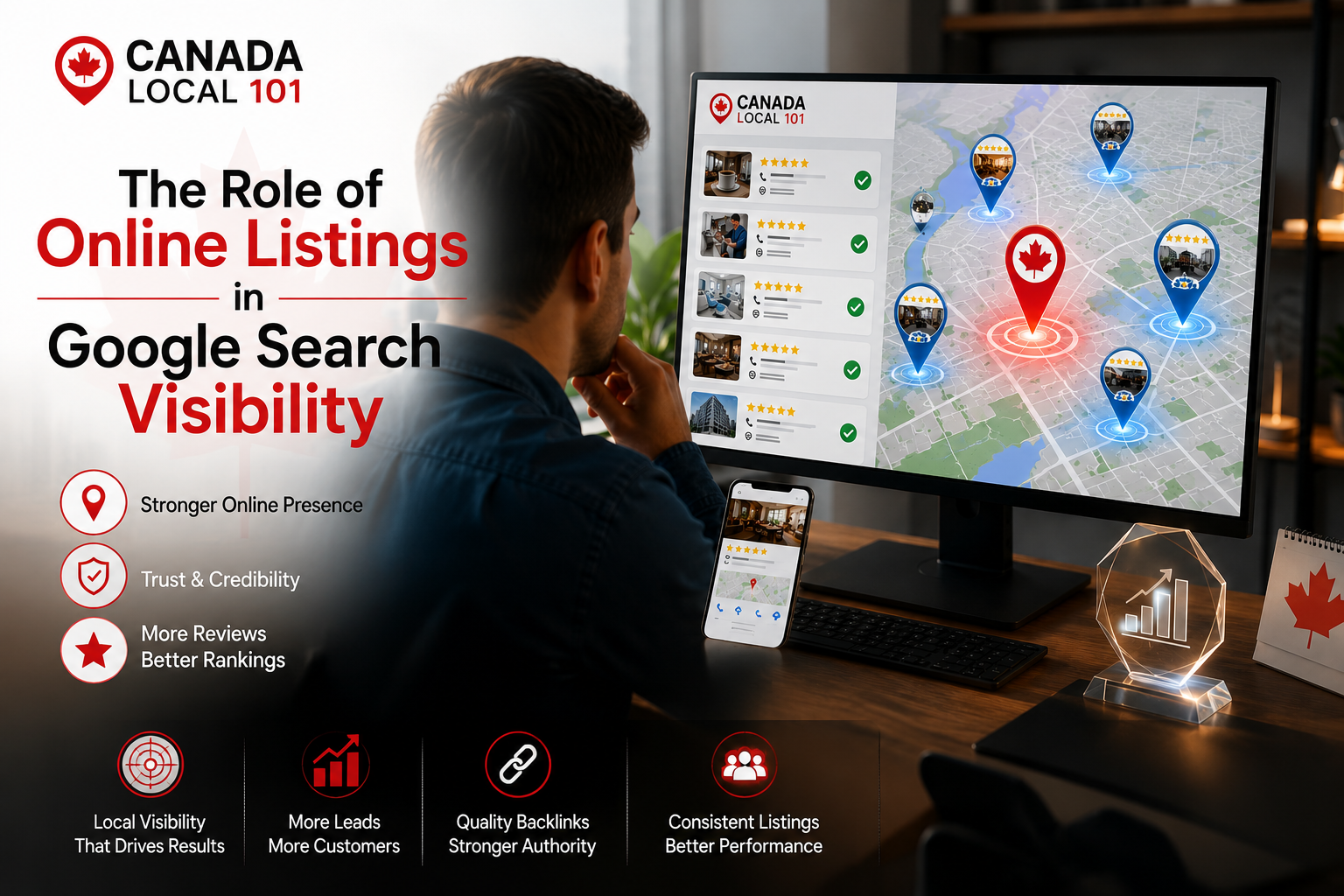
The Role of Online Listings in Google Search Visibility
Canadians business owners understand that Google is responsible for who gets found on the internet. What they may not know is how that decision is made for local searches, and how little of it is about your website.
When a homeowner in Oakville does a search for “roof repair near me” or a parent in Halifax searches for “tutoring services Halifax”, Google does not search websites and simply select the best one. It uses information from a much larger data set, follows it across different platforms, and lists businesses that are credible across them. Online listings are at the core of the data pool, and in 2026, they play a more direct role in local search rankings than ever before.
For small business owners in Canada, this link makes an abstract idea in search engine optimisation (SEO) very tangible. It also explains why two businesses with equally good websites can show up in completely different positions in local search results.
The Citation Signal Explained Simply
What you create when you list a business in a directory is called a citation. A citation is a listing of your business’s name, address and phone number (NAP) on any third-party website in local SEO. So every time you have your business name, address and phone number published on Canada Local 101, Yellow Pages Canada, Yelp or any other trusted directory, it is a citation that Google can track down and confirm.
Google relies on citations for trust. If your business name, address and phone number appear in the same way on multiple credible directories, Google will interpret that as a sign that your business is real, has a stable presence in the real world, and is still in operation. And that trust translates into higher visibility in local search and Google Maps.
The flipside is also true. If your address is presented differently in different places, your phone number is incorrect in some places, or your name varies slightly in others, this introduces confusion. Google doesn’t clear up this uncertainty. It just becomes less certain about your listing, and therefore places you lower in the local search results than another business that has consistent and clean information on every listing.
This is why you must get your citations right from the start, as much as you do with your own website.
The Local Pack and Why It Changes Everything
The most valuable space in any Google local search is the local pack, the map-based block showing three businesses that appears above all organic results. Research consistently shows that this section captures the majority of clicks in local searches. If your business appears there, you receive a disproportionate share of local traffic. If you do not, most searchers never reach your website at all.
Getting into the local pack requires three things working in combination: a claimed and optimised Google Business Profile, clear relevance to the search query, and credibility signals from external sources. That third requirement is where directory listings do their most important work.
If you’re listed correctly on Canada Local 101, this is part of the external validation that Google assesses when determining which three businesses will appear in the local search results. When paired with listings on other Canadian sites, this creates the “citation footprint” that establishes your business as a local, trusted player in your category and city. This external credibility cannot be replaced by web site optimisation, no matter how much effort goes into it.
NAP Consistency Is More Important Than It Sounds
NAP stands for name, address, and phone number. In local SEO, keeping these three details identical across every platform where your business appears is foundational. It sounds simple, but it is consistently one of the most mismanaged elements of local search for Canadian businesses.
Inconsistencies develop gradually and without much notice. A business originally listed as “Chen Landscaping Ltd.” gets shortened to “Chen Landscaping” on a few platforms. The address uses “Street” on the website but “St.” in some directories. A phone number changed eighteen months ago and three directory profiles never got updated. Each of these variations registers as a discrepancy in Google’s data process.
When building or auditing your listings on Canada Local 101 and other Canadian platforms, the NAP information you use should be identical everywhere, down to punctuation and how abbreviations are handled. The exact format on your Google Business Profile should be the exact format on Canada Local 101, on Yellow Pages Canada, and anywhere else your business appears online. This consistency is what allows Google to confidently link all those citations to one verified business and reward it with stronger local visibility.
Canada Local 101 gives Canadian businesses full control over how their information is presented, which makes it a reliable anchor point for establishing the consistent business data that Google’s local index depends on.
Reviews Are a Ranking Input, Not Just a Reputation Tool
Online reviews are more than a matter of perception. They are a quantifiable factor that Google’s local algorithm uses to determine which businesses will appear in local search results.
What Google considers are the number of reviews, average rating, recency of reviews and whether the business actively responds to reviews. A Canadian business with a strong review profile on Canada Local 101 is sending multiple positive signals to Google: that the business is good at keeping customers engaged, is delivering quality products and services, and is being managed by a real human who cares.
For Canadian businesses competing in busy local markets, trades in the GTA, professional services in Vancouver, healthcare providers in Calgary, reviews on credible Canadian platforms are one of the few genuine ranking levers that remain directly in your control. You cannot engineer a higher ranking through shortcuts. But you can ask satisfied customers to share their experience, respond to every review with professionalism, and build a review profile that signals authority to both Google and the people searching for what you offer.
In smaller Canadian cities and towns, the bar is even lower. Many local markets have businesses with minimal or no reviews. Developing a habit of collecting genuine feedback from real customers puts you ahead of the majority of local competitors with very little effort required.
What Directory Backlinks Do for Your Website
Beyond the citation signals that directory listings generate, there is another SEO benefit that often gets overlooked. When Canada Local 101 or another credible Canadian directory publishes your listing with a link to your website, that link carries domain authority from the directory to your site.
Domain authority influences how Google evaluates the credibility of your website relative to others competing for the same local keywords. A physiotherapy clinic in Edmonton with backlinks from several trusted Canadian directories has a stronger authority profile than a competitor with none, everything else being equal. Over time that difference shows up in keyword rankings, particularly for the locally modified search terms that bring the most relevant traffic.
For most Canadian small businesses that are not running link building campaigns or generating press coverage, directory backlinks are the most accessible and legitimate source of external links available. They come naturally as a result of building the directory presence that local SEO requires anyway, which makes them efficient in a way that most other link-building approaches are not.
Directories Feed Voice Search and AI Results Too
Another feature of online listings that is not sufficiently recognised is their impact on search surfaces beyond the Google search results page. Whether a user asks a voice-activated assistant to find a Kelowna dentist, or has a smart AI-powered search surface make suggestions for local businesses, the data that fuels these search surfaces comes from structured business databases supplied by directory publishers.
Canadian businesses that are not regularly listed in trusted directories are not visible to these search platforms. The businesses with accurate and well-reviewed profiles on platforms such as Canada Local 101 are the ones whose data gets integrated into these systems and are then available for search via tools that an increasing number of Canadians now rely upon to find local businesses.
Building a strong directory presence today is not just about how Google’s results page looks right now. It is about making sure your business data is in the right places to surface wherever local search evolves next.
Turning This Into a Practical Habit
The relationship between online listings and Google search visibility is not abstract. It is a documented, measurable dynamic that Canadian businesses can act on directly without significant technical knowledge or budget.
Claim your Canada Local 101 profile and fill every section completely. Make sure your NAP information matches your Google Business Profile exactly. Choose categories that reflect how Canadian customers in your city actually search for your service. Build a genuine habit of asking satisfied customers for reviews and responding to every one that comes in. Check your listings a few times a year to catch anything that has gone out of date before it creates inconsistencies in Google’s index.
These steps are not complicated. But they are the steps that determine whether Google has enough confidence in your business to put it in front of the Canadians who are actively looking for exactly what you offer.
Recent Posts
How Canadian Business Citations Improve Local SEO

Canadian Local Marketing Trends for 2026