
Common Mistakes to Avoid in Canadian Business Listings
The vast majority of Canadian small business owners who bother to set up their business listing in a directory should be commended for doing something their competitors are not. But getting listed and getting results are two different things, and the difference is usually all down to the handful of errors commonly found in listings from Victoria to St. John’s.
These are not complicated errors. They are the types of mistakes you make when your listing is set up in a rush, or no one comes back to look at it once it has been created. The problem is that they all cost you leads, but without any warning signs. You don’t get an email telling you that your inconsistent phone number is negatively affecting your Google ranking. You just get fewer calls than you should.
Here are some of the most common errors Canadian businesses make with their directory listings, and how to fix them.
Inconsistent Business Information Across Platforms
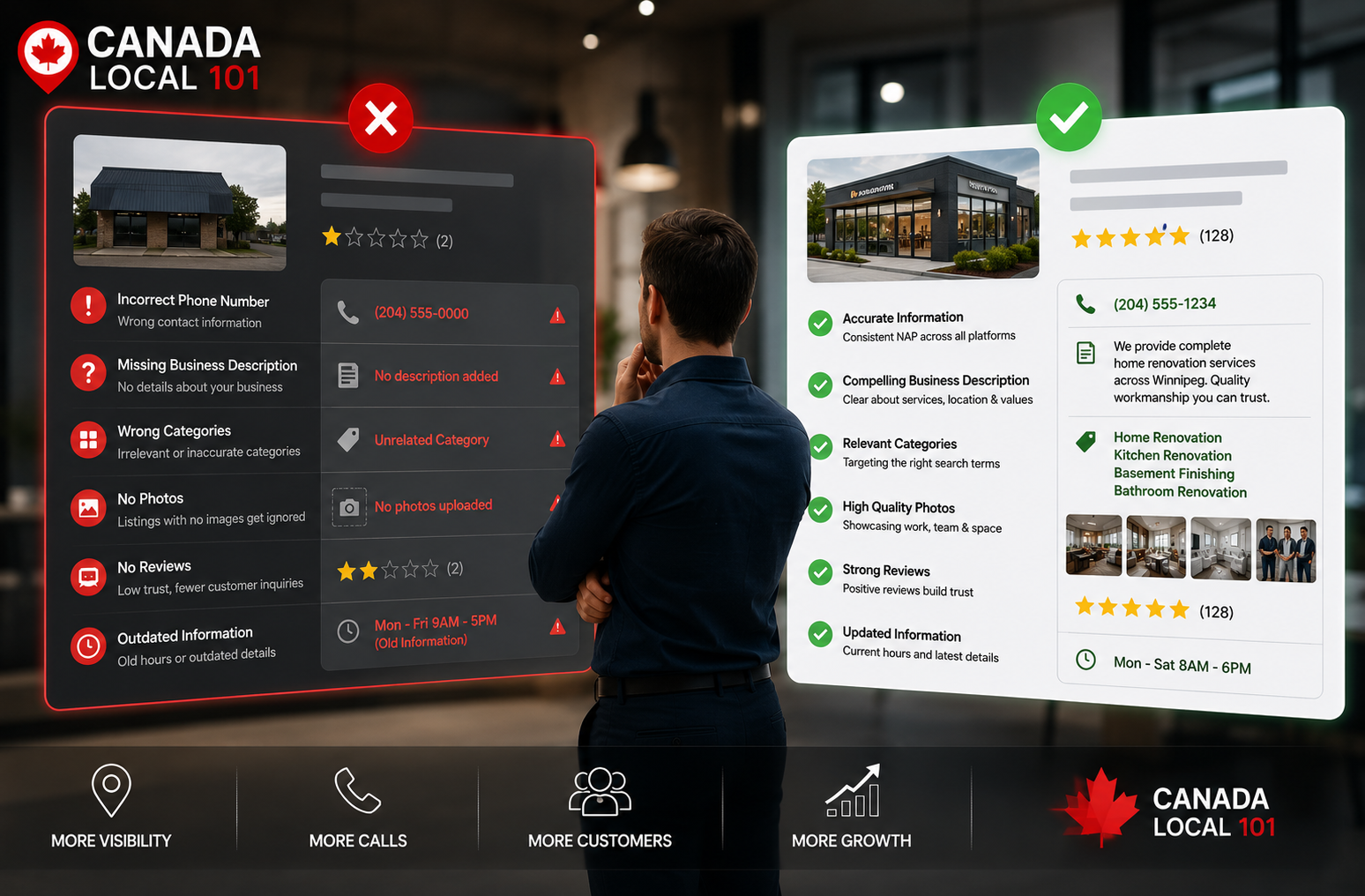
This is the biggest, most common, and most overlooked mistake. The name, address and phone number of your business must be the same across the internet. Not similar. Not close. The same, including how you deal with abbreviations and whether you put a period at the end of “Ltd.”
It’s easy to see how this happens. You create your Google Business Profile listing one month and write out the entire street address. You set up your Canada Local 101 profile several months later and shorten it. You were added to a different directory years ago with an old phone number and haven’t changed it. All of these variations confuse Google’s local algorithm, and it does not assume that the variations were made in error.
Choose one specific format for your business name, address, and phone number. And stick to it, everywhere you go. And check every listing of your business to ensure it’s consistent. This change alone will often lead to better local search rankings.
Leaving the Business Description Empty or Vague
A surprising number of Canadian businesses either skip the description entirely or write one sentence so generic it communicates nothing. “We provide quality services to our valued customers” is not a business description. It is a placeholder that wastes one of the most valuable parts of your listing.
Your description is where Google learns what your business actually does, and it is where a potential customer decides whether to keep reading or move on. Both of those audiences deserve specific, honest information.
Write in plain language. Name your actual services. Mention the Canadian cities or regions you serve. Say something concrete about what makes working with you worth the call. A landscaping company in Kelowna that writes about seasonal lawn care, spring cleanups, and snow removal for Okanagan homeowners is giving Google usable signals and giving customers a real reason to reach out. A company that writes “we offer landscaping services” is giving neither.
Keep it natural. Write the way a real person would describe their own business, not the way a marketing pamphlet reads.
Choosing the Wrong Categories
Category selection feels like a minor decision when you are setting up a listing. In practice it directly controls which searches your business appears for, which makes it one of the more consequential choices you make during the setup process.
The biggest error is to choose one category and not go any further. A contractor specializing in renovations who places their business only under the category “construction” is missing potential customers who search for “kitchen renovations,” “basement renovations” or “bathroom upgrades.”
Go through your Canada Local 101 category options carefully. Start with the primary category that best reflects your main service. Then add secondary categories for each specific service your customers search for individually. The test for each one is whether a real person in your city would type that phrase into Google when looking for your service. If yes, it belongs on your profile.
Avoid selecting categories that are not genuinely relevant to what you do. Padding a profile with loosely related categories does not increase visibility. It confuses the algorithm and can reduce how relevant your listing appears for the searches that actually matter to you.
No Photos on the Profile
Without photos a listing doesn’t communicate anything about the experience. Customers want to see the product, the office, the people, or the portfolio before they decide to contact. When there are no images, many of them simply move on to a listing that shows them something.
The fix here is straightforward. Upload real photos from your actual business. Completed projects for trades and contractors. The dining room and dishes for restaurants. The office or clinic space for professional services. Your team is doing the work they do every day.
Do not rely on stock photography. Canadians recognize it quickly and it creates an impersonal impression that works against a local business trying to build trust. A few honest, well-lit photos taken on a phone will consistently outperform generic library images in the trust they generate with real people.
Add new photos periodically. An active photo profile signals to both users and platforms that your business is current and engaged.
Ignoring Reviews Completely
Some companies simply gather a handful of reviews and then ignore them. Others don’t even get into the habit of generating them. These businesses are missing out on a lot of potential.
Your local search performance is affected by reviews. Google’s algorithm considers the volume of reviews, the average star rating, the recency of reviews and whether reviews are responded to. A Canada Local 101 profile with 30 authentic reviews and an established record of responding to reviews with some professionalism is sending several “good signals” to Google. A profile with two reviews from two years ago is sending almost none.
Make a habit of asking for reviews. After a successful job, after a great meeting or appointment, at the conclusion of a successful transaction. A personal, direct ask works far better than a generic follow-up email. Generally, people who enjoyed their experience will be happy to say so when asked.
Reply to all reviews, positive and negative. For positive ones, keep it short and authentic. For negative reviews, be professional, deal with the complaint and propose a way to fix it offline. The customers can see these interactions, and a calm response to criticism is more likely to generate trust than to drive them away
Outdated Information That Nobody Has Corrected
Businesses change. Hours shift around Canadian statutory holidays that vary by province. Phone numbers get updated. Service areas expand. New services get added. When these changes happen inside the business but not inside the listing, anyone who finds you through Canada Local 101 gets wrong information and that costs you real opportunities.
Schedule a reminder to audit your listing every 3-4 months. Double-check that your business hours, contact information, service description, and category information has not changed. Ensure your name, address and phone number are still correct as per your Google Business Profile.
This is maintenance that takes very little time but makes a real difference in how consistently your listing performs. The businesses in Canada getting steady leads from their directory presence are the ones who treat the listing as something worth keeping current, not something they set up once and never thought about again.
Small mistakes in a directory listing do not announce themselves. They just quietly reduce the calls, clicks, and customers you should be receiving. Fixing them is not complicated, but it does require actually going back and looking.
Recent Posts

How Canadian Business Citations Improve Local SEO

Canadian Local Marketing Trends for 2026