
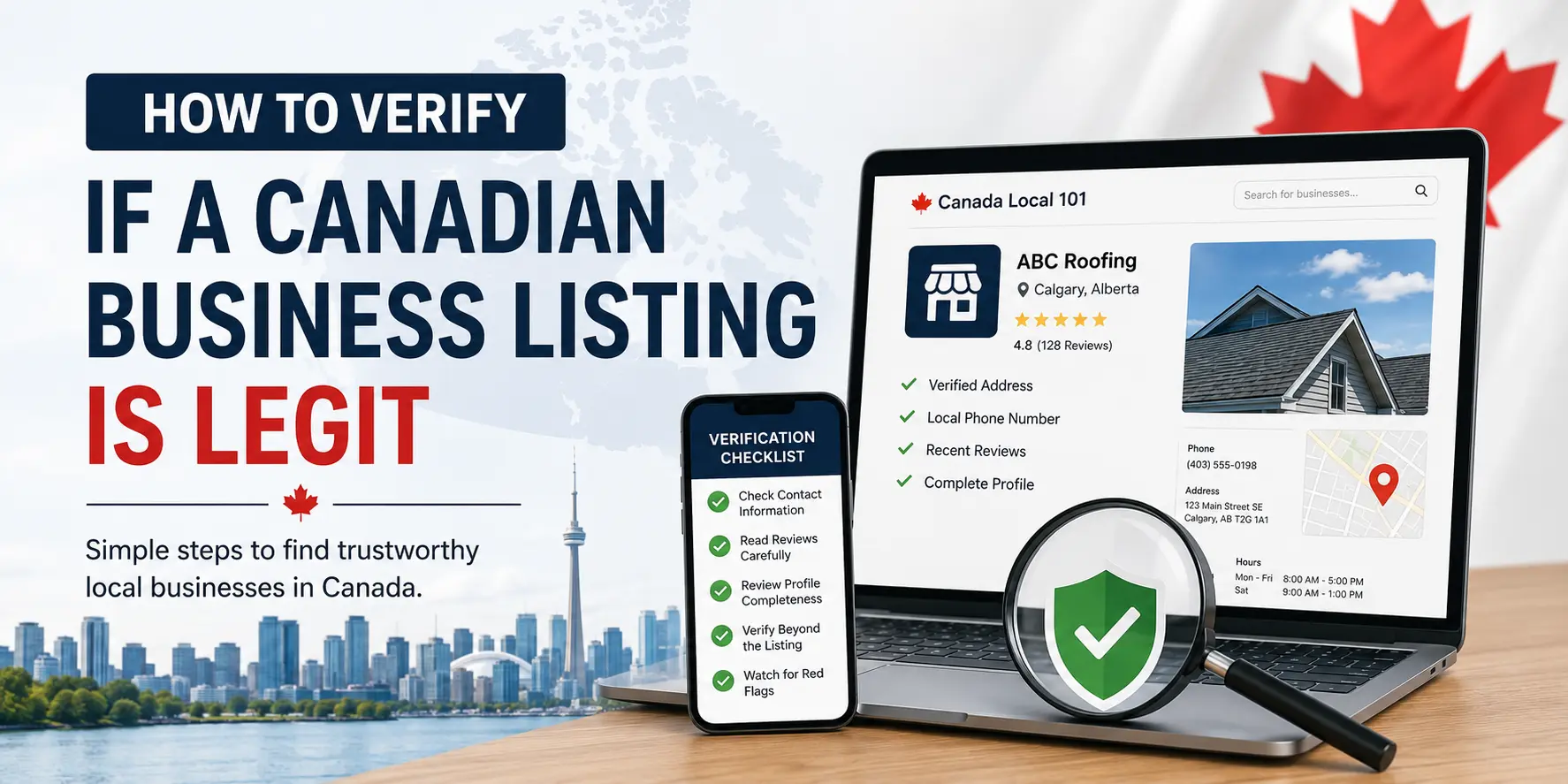
How to Verify If a Canadian Business Listing Is Legit
Not Every Listing Deserves Your Trust
There are millions of businesses operating in Canada, and increasingly, they have an online presence, whether that’s in local directories, Google, or on social media. That’s a good thing for customers. But it also means that not every listing you see has been verified, updated, or even initiated by the business it’s supposed to be associated with.
Some listings are outdated and nobody has touched them in years. Some were created by third-party data aggregators pulling information from old sources. A few are even intentionally inaccurate.The problem for a Canadian consumer wanting to find a trustworthy local business is that listings can look like gold on the surface, but be inaccurate, abandoned or simply not worth the visit.
The ability to scrutinise a listing before you contact someone is an important skill to save time and avoid disappointment. Here’s how to do it right.
Start With the Contact Information
Contact information is where the issues are most likely to lie and the easiest to spot. First of all, look at the phone number, address, and name and ask yourself whether they pass the basic scrutiny.
A business listing on a Canadian website such as Canada Local 101 will have an area code that corresponds to the city or province listed as the company’s service area. A Winnipeg roofing company with a 204 area code is legit. The same company with a different area code, with no reason provided, is suspicious.
The address should be an actual, specific location. Look it up on a map and make sure it is a commercial or residential address that makes sense for the business. A landscaping company operating out of a verified business address in the neighbourhood they serve is reasonable. If the address is not on any map or is the wrong type of location, it’s a warning sign.
If the business listing includes a website, check the phone number and address there. Most established Canadian businesses have the same details for their phone numbers and addresses on their directory listing, their website and their Google Business Profile. If the information is inconsistent, that’s something to consider.
Look at the Review Profile as a Whole
Reviews are one of the most reliable indicators of whether a business listing reflects a real, operating company with actual customers. But reading a review profile properly means looking at more than the star rating.
Check the following when evaluating reviews on a Canada Local 101 listing:
- Review recency:
If a company has a good overall review rating, but no reviews in the last 12 months, it’s a cause for concern. Businesses that are operating and have customers will usually receive reviews. A sudden end to the stream of reviews could indicate the business has closed, or its operation has changed.
- Specificity of reviews:
Authentic reviews from real Canadian customers are specific. They refer to the service provided, the name of the person who served them, or the circumstances. Vague five-star reviews with no context are easier to fabricate and harder to trust.
- Volume relative to age:
A business that claims to have been in business for a decade in Calgary but has just three reviews is either not reaching many customers or is not soliciting feedback. Neither situation is particularly reassuring.
- Owner’s response:
When a business owner replies to positive and negative reviews, that shows engagement. An owner who is professional in responding to a complaint and is willing to make amends is demonstrating how they work when things go wrong. This is more important than the unfiltered five stars.
- Rating consistency:
If a business has a high profile on Canada Local 101 but low reviews elsewhere, take some time to investigate before contacting them.
Check How Complete the Profile Is
A full listing is a sure sign of trust. Completing a directory listing takes effort and thought, and such businesses are almost always more reliable than those that have not.
On Canada Local 101, a complete listing has a detailed description of the business, including services that the business actually provides, and Canadian neighbourhoods that the business actually serves. It has accurate operating hours. It has images that depict real services, people or premises. It has a service area that covers the area you are searching in. It has up-to-date and consistent contact information.
An entry that is largely blank, contains vague language, no photos, and no information about the types of services the business offers is cause for concern. It could just be a company that has not taken the time to build out its profile. But it could be that the profile has not been maintained because nobody with real ownership of it is paying attention.
A complete profile is not necessarily a sure sign of authenticity, but it is a reasonable test to determine if the profile is owned by a business person.
Verify the Business Exists Beyond the Listing
A listing on any single platform is one data point. Confirming that a business exists and operates as described requires checking a couple of additional sources, which takes only a few minutes.
Search the business name directly and see what else comes up. A legitimately operating Canadian business typically has some kind of web presence beyond a single directory listing, even if it is modest. A simple website, a Google Business Profile, or mentions in local community pages all suggest a business that has been operating in the real world.
Check whether the business is registered in the relevant Canadian province. Most provinces have publicly accessible business registry searches online. Confirming that a business name is registered in British Columbia, Ontario, Alberta, or whichever province is relevant to your search adds a meaningful layer of verification that takes under two minutes.
Look for local media coverage, community activities or other signs that the business has a Canadian presence in the community in which it operates. A roofing company that’s been in business for eight years in Halifax will often have some kind of footprint other than a basic business listing.
Watch for These Specific Warning Signs
Some patterns in a business listing consistently indicate something worth investigating before you proceed.
Signs that deserve a second look:
- The business description is written in a generic way that could apply to any city in the world, with no mention of Canadian cities, landmarks or service regions
- The phone number leads to a voicemail that does not include the name of the business
- The business has a virtual office or mailbox service instead of an operating address
- The reviews were all posted within a short timeframe, especially if there are lots of positive reviews with little detail
- There are no images for the listing despite the company claiming to be established for a long time
- The website URL has a broken link, is in development, or does not appear to be related to the business at all
Each of these signs on their own is not necessarily a red flag. But when the combination of these appears in any one listing, it’s worth taking notice before you commit to making a deposit or letting someone into your home.
Use Canada Local 101 as Your Verification Anchor
One of the practical benefits of using a Canadian directory such as Canada Local 101 is that the system is based on Canadian business data and Canadian geographic indexing. The listings on the website are narrowed down by Canadian cities and categories, and therefore, businesses listed there have opted into a Canadian local search environment.
This doesn’t mean all listings on any directory are necessarily verified. It does mean that the structure of the website, with its geographic/categorical approach, provides a more relevant context for assessing Canadian businesses than a global collection in which Canadian listings would be intermingled with millions of others from outside the country.
By using Canada Local 101 as your starting point on the web and then following the verification tips and tricks above, you have a dual strategy that offers convenience and security.
Conclusion
Discovering a reputable local business in Canada has never been so easy, and never so challenging when it comes to verification. Canada’s online directories contain many listings that are great, some that are out-of-date, and some that are not worth visiting.
The good news is that verifying a listing does not require expertise or significant effort. Verifying the contact information, reviewing the full review rather than star rating, checking the business exists beyond the listing and checking the specific red flags outlined above provides a Canadian consumer with a simple way to make the right choices.
Canada Local 101 is designed to provide Canadians with a reliable platform to find local businesses and for local businesses to accurately represent themselves to Canadians. When you put the right platform with the right verification process, you can find a local business you can trust without taking a risk.
Recent Posts
How Canadian Business Citations Improve Local SEO
Canadian Local Marketing Trends for 2026