
How Canadian Business Citations Improve Local SEO
If you’ve ever searched for your own business online and discovered your name, address, or phone number was misrepresented in a directory you don’t remember signing up for, you have already experienced business citations. The majority of Canadian small business owners are familiar with citations, but their knowledge is incomplete regarding why they are important or what they should do about them.
This blog will help you clear that up. How citations function in the Canadian marketplace, how they impact local rankings and the correct way to create a citation strategy for a small business seeking local growth.
What a Business Citation Actually Is
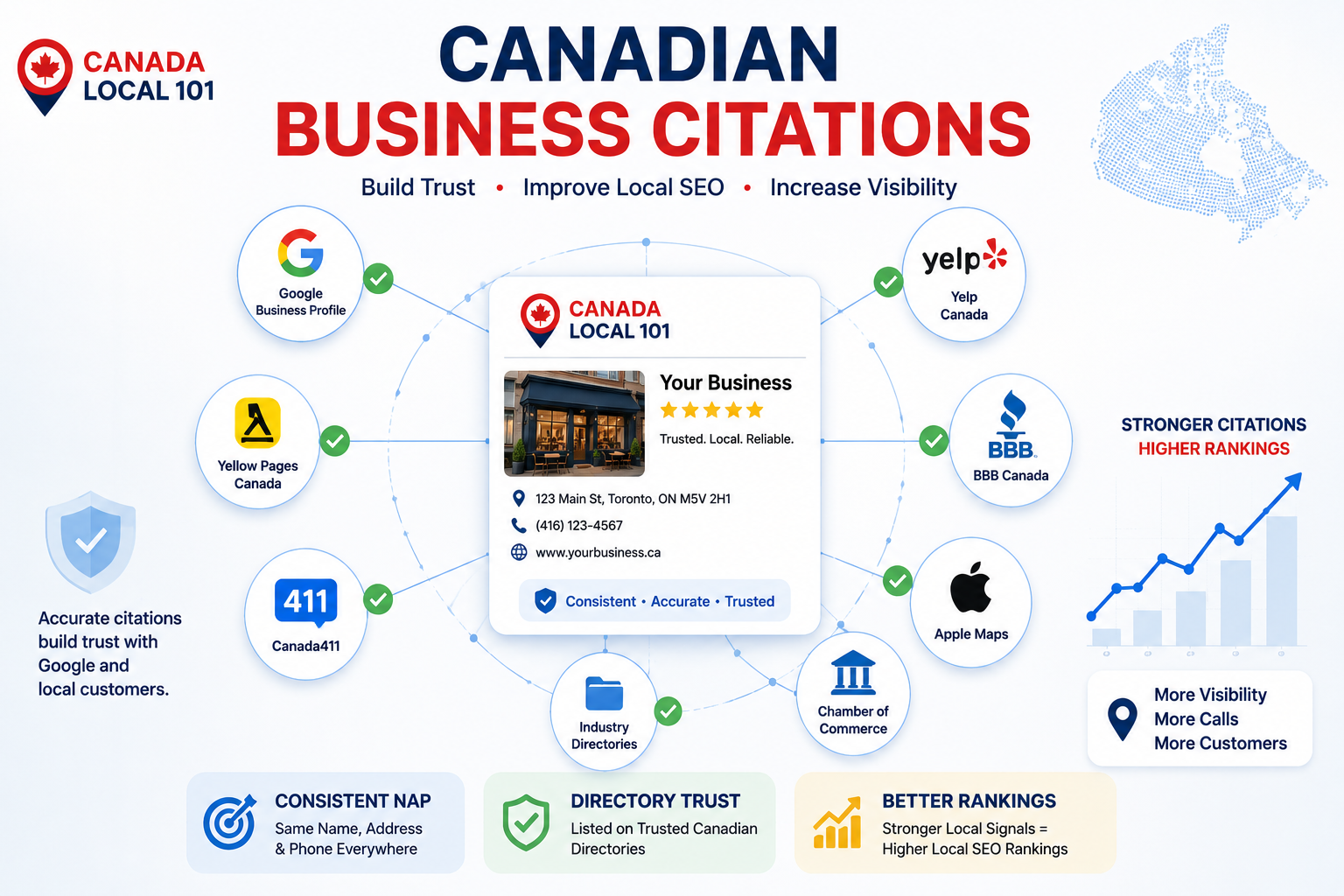
Any information on an external website about your business name, address, and phone number is considered a business citation. This is often known as the NAP: Name, Address, and Phone Number.
Citations show up in places like
- Online business directories include Yellow Pages Canada and Canada411.
- Check out review sites such as Yelp Canada and Google Business Profile.
- Directories specific to your industry or profession.
- Local Chamber of Commerce sites
- Any social media profiles that have your business information listed on them
- Any news articles or blog posts that refer to your business information
Each time your NAP is present on a reputable external website, it tells Google that your business is legitimate, has a presence, and is trustworthy. That’s a direct influence on your rankings for local search.
Why Citations Matter Specifically in Canada
While citations are an important factor in local search in any country, there are several reasons why they hold special significance for Canadian businesses.
The Canadian directory landscape is fragmented
In some countries, there is one or two directories of choice, while in Canada, there are country-wide, province-wide and city-specific directories which are all relevant to your local image. Google reviews all of them in determining your credibility.
Canadian consumers still use directories
Directories, such as Yellow Pages Canada and Canada411, are an active resource that Canadians use to find local businesses, with older Canadians more likely to be using it than the younger generations. This kind of citation is not only an SEO signal, but it’s a genuine source of traffic.
Province-specific trust signals matter
A BC Chamber of Commerce directory, a local Vancouver business association listing and a provincial industry body website have stronger local trust signals as compared to just appearing on generic national directories. Google knows about geography and values local sources according to it.
The Difference Between Structured and Unstructured Citations
Not all citations are the same format and understanding the difference helps you build a more complete citation profile.
Structured citations
These are formal directory listings where you fill out a profile with your business name, address, phone number, website, hours, and sometimes a description. Google Business Profile, Yelp Canada, and Yellow Pages Canada are all structured citation sources. These are the ones most people think of when citations come up.
Unstructured citations
These are mentions of your business details on websites that are not directories. A local news article that names your business and lists your address, a blog post that recommends your service and includes your phone number, or a community forum post that references your location are all unstructured citations. They are harder to build deliberately but often carry strong authority because they come from editorial sources rather than self-submitted directories.
A solid Canadian citation strategy builds both. Structured citations create consistency and coverage. Unstructured citations build authority and credibility in ways directories cannot replicate.
The Canadian Directories That Matter Most
Not every directory carries equal weight. Submitting your business to hundreds of low-quality directories does very little. Focusing on the right ones does a lot.
National Canadian directories worth prioritizing
- Google Business Profile: the most important citation source for any Canadian business
- Yelp Canada: high authority and actively used by Canadian consumers
- Yellow Pages Canada (yellowpages.ca) : still widely trusted and indexed well by Google
- Canada411: a long-established Canadian directory with strong domain authority
- BBB Canada: carries credibility, particularly for service-based businesses
- Bing Places: often overlooked but feeds Microsoft and Apple search products
- Apple Maps: increasingly important as Siri and Apple Maps usage grow in Canada
Industry and region-specific directories to consider
- HomeStars: essential for Canadian home service and trades businesses
- RateMDs: relevant for healthcare providers across Canada
- Zomato and OpenTable: for restaurants and hospitality businesses
- Your provincial or territorial Chamber of Commerce directory
- Your city’s local business improvement area (BIA) directory if one exists
- Industry association directories relevant to your trade or profession
What Inconsistent Citations Do to Your Rankings
This is where a lot of Canadian small businesses quietly hurt themselves without realizing it.
Common inconsistency problems that damage local rankings
- Business name listed differently across directories (abbreviations, punctuation differences, or legal name versus trading name variations)
- Old address still showing on directories after a business moved
- Multiple phone numbers appearing across different listings
- Duplicate listings for the same business on the same directory
- Website URL listed without consistent formatting across citations
Google cross-references your business information across all of these sources. When it finds conflicting information, it loses confidence in which details are correct. That uncertainty reduces your local ranking rather than helping it.
How to audit your existing citations
- Search your business name in Google and look at what appears across different websites
- Search your phone number and address separately to find listings you may have forgotten about
- Use your business name variations to catch listings that do not match your current trading name
- Check for duplicate listings on major directories and request removal of outdated ones
Building Citations the Right Way in Canada
A practical approach that works
- Start with Google Business Profile and make sure every field is complete and accurate
- Work through the major national Canadian directories and submit or claim your listing on each one
- Move to industry-specific and province-level directories relevant to your business
- Keep a simple spreadsheet tracking where you are listed and what information is on each one
- Review and update your citations whenever your address, phone number, or business name changes
Consistency is the entire game with citations. The information you submit to your first directory becomes the standard that everything else needs to match. Get it right from the start and maintaining it becomes much simpler.
Citations Are a Foundation, Not a Shortcut
Building a strong citation profile across Canadian directories will not shoot you to the top of local search results overnight. What it does is create a base on which every other local SEO campaign works on.
If a business has citations that are consistent and accurate across reputable Canadian business directories, then a clear story is communicated to Google regarding what the business is and the locations from which it trades. That clarity builds up over time. With targeted, authentic reviews, local content, and an active Google Business Profile, citation is one of the most long-term local SEO assets Canadian small businesses can have.
Get the basics right, keep them consistent and let the signal build.
Recent Posts
How Canadian Business Citations Improve Local SEO

Canadian Local Marketing Trends for 2026