
The Future of Online Business Directories in Canada
Every couple of years, a new technology comes along, and someone claims that business directories are about to become obsolete. They were going to be replaced by social media. Mobile applications were going to make them obsolete. AI search was going to complete the task all by itself. But Canadian consumers continue to search for local businesses in the same basic way as they always have—by finding a trusted source that provides information on who is in business, what they have to offer and if anyone has had a positive experience with them.
Business directories are not becoming useless; only the way they are used is changing. It is how they operate, what they are connected to and how Canadian businesses should handle how they fit into them in order to remain visible as search technology continues to evolve. Knowing where things are going will enable Canadian small businesses to make wiser decisions today regarding the foundation of tomorrow.
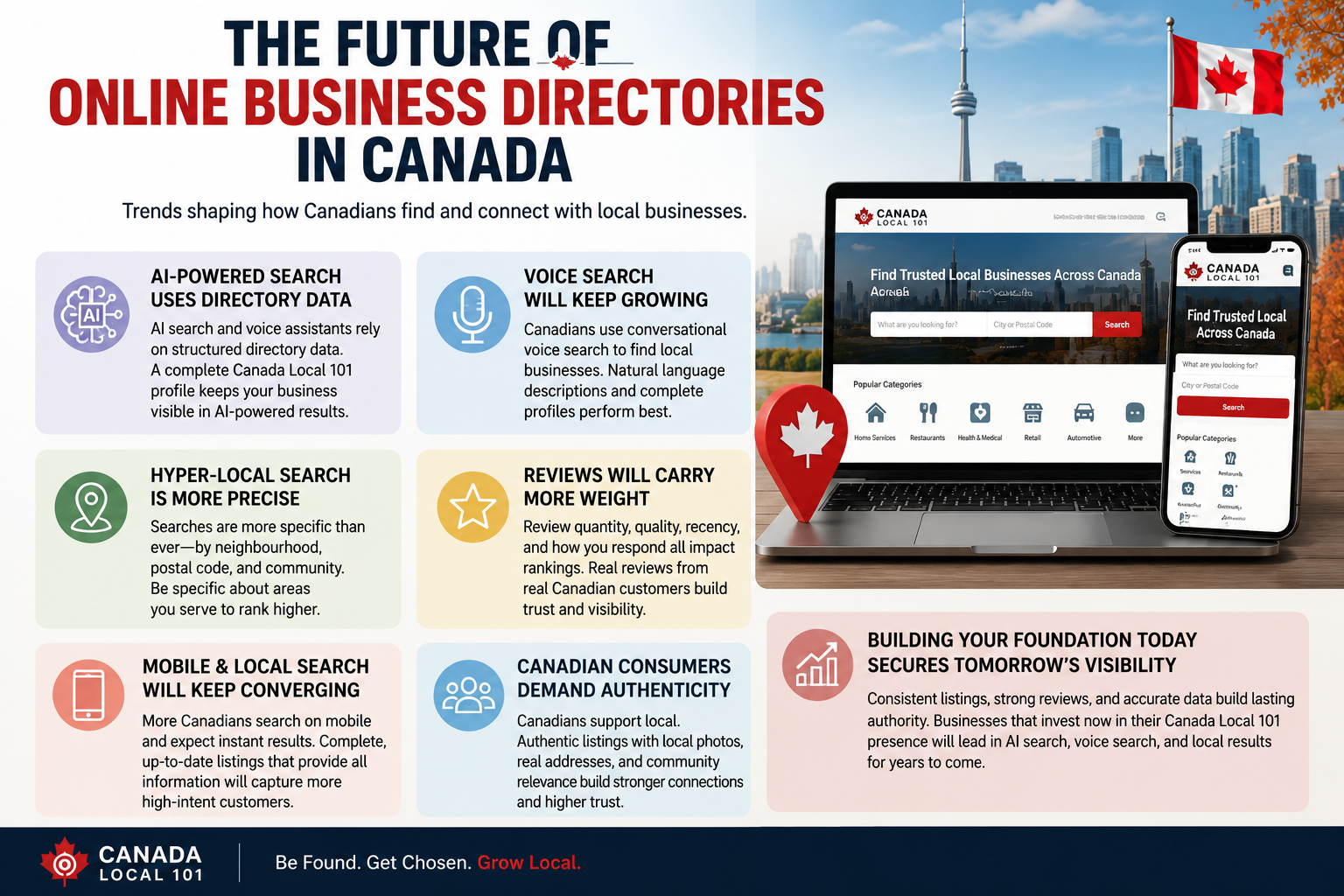
AI-Powered Search Is Not Replacing Directories, It Is Consuming Their Data
With the emergence of AI-powered search platforms, Canadian business owners are uncertain whether directory listings are still relevant. But the answer to this question is clear when you understand what these AI tools are powered by.
An AI search engine providing a local business recommendation or a voice assistant giving the name of the top HVAC contractor in a city in Canada can’t just pull that information out of thin air. It’s leveraging the structured business databases maintained by directory platforms. The information that Canada Local 101 has about Canadian businesses, such as their name, address, phone number, service category, review data and geographic information, is the type of structured data that AI search systems use to create local recommendations.
A Canadian business with a complete, accurate, and well-reviewed Canada Local 101 profile is feeding clean, credible data into the systems that power AI-assisted search. A business with no directory presence, or an incomplete and inconsistent one, is effectively invisible to these emerging search surfaces regardless of how good their website is. The future of AI local search is built on directory data. That is not speculation. It is how these systems are architected right now.
Voice Search Will Keep Growing in Canadian Households
Smart speakers, voice-enabled phones, and connected home devices have become a fixture in Canadian households across every province. The way Canadians use voice search for local business discovery is distinct from how they type searches, and those differences matter for how directory listings need to be built.
Voice queries are conversational and specific. A Canadian asking their smart speaker to find a reliable dentist accepting new patients in Burnaby is asking a complete question in natural language. The system answering that question draws from structured directory data and prioritises businesses with complete profiles, strong review signals, and geographic information that precisely matches the location being asked about.
Canadian businesses that write their Canada Local 101 descriptions in plain, natural language reflecting how real customers describe their services are better positioned for voice search than those using technical industry terminology. A plumbing company in Edmonton that describes emergency drain cleaning, pipe repairs, and hot water tank installation for residential customers is using the language a Canadian would actually speak to a voice assistant. That alignment between how the listing reads and how Canadians ask questions is going to become increasingly valuable as voice search continues to grow.
Hyper-Local Search Is Becoming More Precise
The geographic precision of local search in Canada has been sharpening over time and this trend will continue. Canadians are not just searching by city anymore. They are searching by neighbourhood, by postal code, and by specific community areas within larger cities.
A homeowner in the Westboro neighbourhood of Ottawa searching for a renovation contractor wants results from contractors who know and operate in that specific area, not just someone claiming to serve the entire Ottawa region. A small business owner in East Vancouver searching for an accountant is looking for someone familiar with that part of the city.
Canada Local 101’s structure around Canadian cities and specific service areas positions it well within this trend toward hyper-local precision. Canadian businesses that are specific about the communities and neighbourhoods they serve in their listing descriptions will benefit increasingly as search algorithms become better at matching geographic specificity in listings to the precise location intent expressed in searches.
Reviews Will Carry Even More Algorithmic Weight
The role of customer reviews in determining local search visibility has grown consistently over the past several years and there is no indication that trend is reversing. If anything, the signals that reviews send to search algorithms are becoming more sophisticated and more influential over time.
Future local search ranking will place even greater weight on review velocity, review authenticity, the semantic content of what reviews say, and how businesses respond to feedback. A Canada Local 101 profile with a steady flow of recent, genuine reviews from real Canadian customers, combined with professional owner responses, is building the kind of review infrastructure that will matter more in two years than it does today.
Canadian businesses that develop a genuine habit of collecting honest customer feedback now are building an asset that compounds in value over time. Those that continue treating reviews as an afterthought are falling progressively further behind competitors who are taking this seriously.
Mobile and Local Search Will Keep Converging
The majority of Canadian local searches already happen on mobile devices and this proportion will only increase. The convergence of mobile technology and local search means that the businesses appearing in mobile local results are capturing an ever-growing share of the moments when Canadians are actively ready to hire someone.
Future mobile search behaviour in Canada will be even more immediate and action-oriented than it is today. Canadians will expect to find a business, verify its credibility, read recent reviews, and make contact within a single session on their phone. Directory listings that provide all of this information cleanly and completely are built for this behaviour. Incomplete listings that force a Canadian to go elsewhere to find basic information are going to see declining engagement as mobile search habits continue tightening.
Canada Local 101 listings with accurate hours, current photos, complete contact details, and strong review profiles are already aligned with where mobile local search is heading. Maintaining that completeness over time is what keeps a listing competitive as mobile behaviour evolves.
Canadian Consumers Will Continue Demanding Local Authenticity
As search technology continues to evolve, one thing is certain: Canadians will continue to prioritize local businesses that are truly connected with their communities. Canadians have always shown a preference for supporting local businesses over national chains and it is apparent in their search and assessment of local business listings.
A Canada Local 101 listing that is genuine, showing real photos from familiar Canadian neighbourhoods, reviews from real local customers, contact information that matches a real local address, and a description of services that includes the Canadian cities and neighbourhoods, resonates directly to this preference. It represents a business in an authentic way that can’t be done with generic or globally aggregated listings.
Canadian consumers are becoming more savvy at judging the authenticity of what they encounter online, and they will increasingly prefer to see listings that are authentic and genuine to the local business area over those that could apply to any business, anywhere. Canada Local 101’s geographic specificity and Canadian focus is increasingly meeting the needs of Canadian consumers searching locally.
The Businesses Building Their Foundation Now Will Benefit Most
The online business directories of Canada are in the hands of the businesses that consider their directory presence as a long-term investment instead of short-term work. Over the years, citation consistency is built, review profiles are earned through real customers, and the complete listings are kept up to date through evolving business activities, making it hard for competitors to unseat.
Canadian small business owners who make smart investments in their Local 101 presence today, ensuring that they get it right and keep it consistent, are investing in all the future changes of local search technology. The data they add now, the reviews they solicit, and the consistency they achieve for their citations will directly influence how Canadians discover businesses for years to come, via AI systems, voice search and hyper-local algorithms.
The directory won’t be removed. It’s quickly emerging as the infrastructure for all that’s coming next.
Recent Posts

How Canadian Business Citations Improve Local SEO

Canadian Local Marketing Trends for 2026