
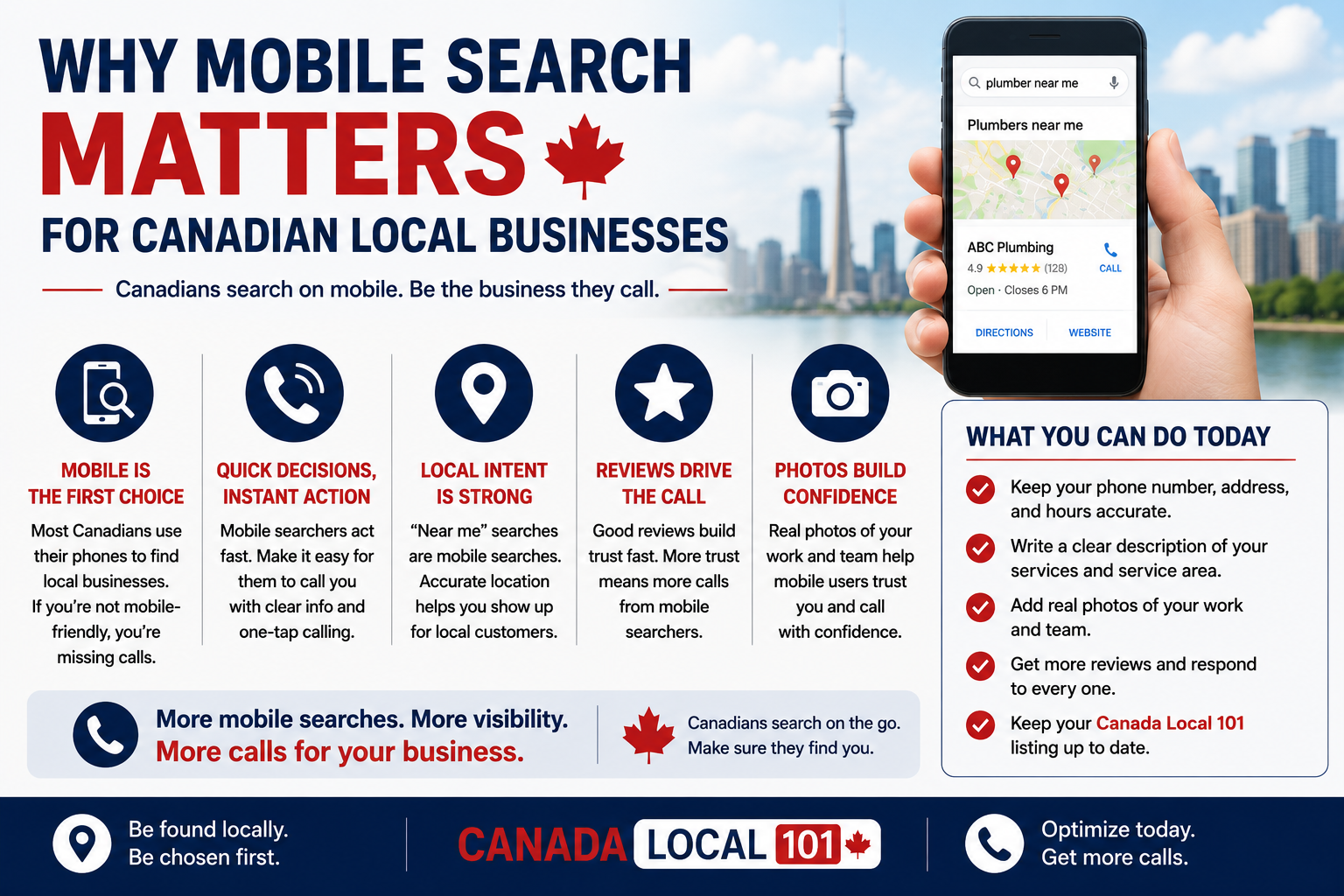
Why Mobile Search Matters for Canadian Local Businesses
A few years ago, when someone in Canada was searching for a plumber near them, a restaurant, or a contractor, they would reach out to a neighbour, try the Yellow Pages or drive by a store they had heard of. The behaviour has now changed for good. The first step today is virtually always the same: to reach for the phone.
Canada’s mobile search habits are now the top way to find and connect with local businesses. More than 94% of Canadians are online and most local searches are conducted on mobile devices, not desktops. The one change alters everything about how Canadian businesses need to present themselves online, and those who haven’t adapted to this reality are missing out on customers they have never even had a chance to talk with.
What Happens in a Mobile Local Search
To better understand the importance of mobile local search for Canadian businesses, it is helpful to consider what the experience would be like from the customer’s perspective.
A Barrie homeowner notices that the furnace isn’t functioning correctly on a cold October night. They pick up their cell phone, type in “furnace repair near me” or “furnace repair Barrie,” and in seconds, they are presented with a list of options. They check star ratings, see who’s available today and read the recent reviews. In 60 seconds, they have made a decision and they are calling a number.
It was all done on a mobile device. The company receiving the call had to be one of the best furnace repair companies in Barrie, but not necessarily the best. The one that showed up in the results, it had a complete and believable profile, recent reviews and it had a phone number visible on the screen you could tap directly. Businesses that didn’t come up in those results were simply not part of the decision.
That’s what mobile local search is and that’s how it unfolds every day in every service category for every Canadian city.
Mobile Search Behaviour Is Different From Desktop
Canadian consumers searching on mobile devices behave differently than they do on desktop computers and those differences have direct implications for how a local business listing needs to be built.
Mobile searchers act faster. They make decisions within seconds rather than minutes and they are far more likely to call directly from a search result rather than clicking through to a website first. A Canada Local 101 listing with a visible, tappable phone number captures this behaviour directly. A listing without clear contact information forces the searcher to take extra steps and most of them simply will not bother.
Mobile searchers also use different language. Voice search through phones and connected devices has grown significantly across Canadian households, and voice queries tend to be conversational and specific. A Canadian asking their phone to find the best electrician in their neighbourhood is not typing a two-word search. They are speaking a complete sentence in natural language. Listings and business descriptions written in plain, natural language that reflects how real customers talk about their needs are better positioned to surface in these results than those using formal industry terminology.
Location intent is stronger on mobile as well. Near me searches are overwhelmingly a mobile behaviour. When a Canadian searches for a service near me they expect results that are geographically precise and immediately actionable. A Canada Local 101 listing with accurate location data, a specific service area, and consistent NAP information across platforms is built to capture this traffic. A listing with inconsistent or vague location details gets filtered out before the customer ever sees it.
Why an Incomplete Listing Costs You Mobile Calls
The primary reason for Canadian small businesses not being in mobile search calls is not because they’re not in directories at all. It’s because their listings are incomplete, out-of-date, or created in a way they’re not built for mobile users to interact with.
A listing that doesn’t reveal the phone number leads to a loss of potential mobile searchers who were ready to call. An outdated business hours listing makes people frustrated when they call and get a voicemail message with the hours they believe are current. A listing without images provides the mobile user with nothing to consider during the few seconds they are deciding on whether to tap the call button or scroll to the next listing.
On Canada Local 101, a well-constructed listing would cover each of these issues. An easy-to-find local telephone number that can be tapped directly into from any mobile phone. Correct and up-to-date business hours, including adjustments for Canadian statutory holidays (which differ by province). Real photos of work done, real staff, real premises, something to evaluate in seconds for the mobile user. A plain language service description that right away verifies that this company provides the services that the searcher is interested in within the city that the searcher is looking in.
Each of these factors diminishes the friction between a mobile searcher discovering your listing and deciding to call you. Eliminating that friction is what turns search traffic into real phone calls.
Local Pack Placement Is Even More Critical on Mobile
On a desktop screen, a Google local search result shows a map, the local pack of three businesses, and several organic results all visible at once. On a mobile screen the local pack takes up the entire visible area before any scrolling happens. The three businesses appearing in those map-based results capture a disproportionate share of all mobile local clicks because on a small screen, they are simply what appears first.
Earning placement in the local pack requires consistent citation signals from credible Canadian platforms. A complete and accurate Canada Local 101 listing contributes directly to the citation footprint Google uses to verify a business’s geographic legitimacy and determine local pack placement. Combined with a properly maintained Google Business Profile and consistent NAP data across other Canadian platforms, this citation consistency directly influences whether your business appears in those three results that dominate the mobile screen.
For Canadian small businesses competing for local customers, local pack placement on mobile is one of the highest-value outcomes available and directory listing consistency is one of the most practical ways to work toward it.
What Canadian Businesses Should Do Right Now
The companies that are getting the most mobile search calls in their Canadian cities aren’t always the largest or oldest. They’re the ones with complete listings, accurate contact details, fresh and authentic reviews and a description that resonates with the mobile searcher’s current needs.
If you don’t have a Canada Local 101 profile, claim one now! Provide full details of accurate and up-to-date information in every section. Ensure the same phone number, address, and business name are used in your Google Business Profile and website. Include actual images of past work. Develop a real culture of soliciting feedback from delighted customers and respond to all feedback received from happy clients.
Canadian local businesses can’t afford to wait around for mobile search to happen. It is the way the majority of your potential customers are doing right now when deciding on which businesses are the best to choose. One of the easiest and most direct ways to ensure your business is part of that conversation is to have a well-constructed Canada Local 101 listing.
Recent Posts

How Canadian Business Citations Improve Local SEO

Canadian Local Marketing Trends for 2026