
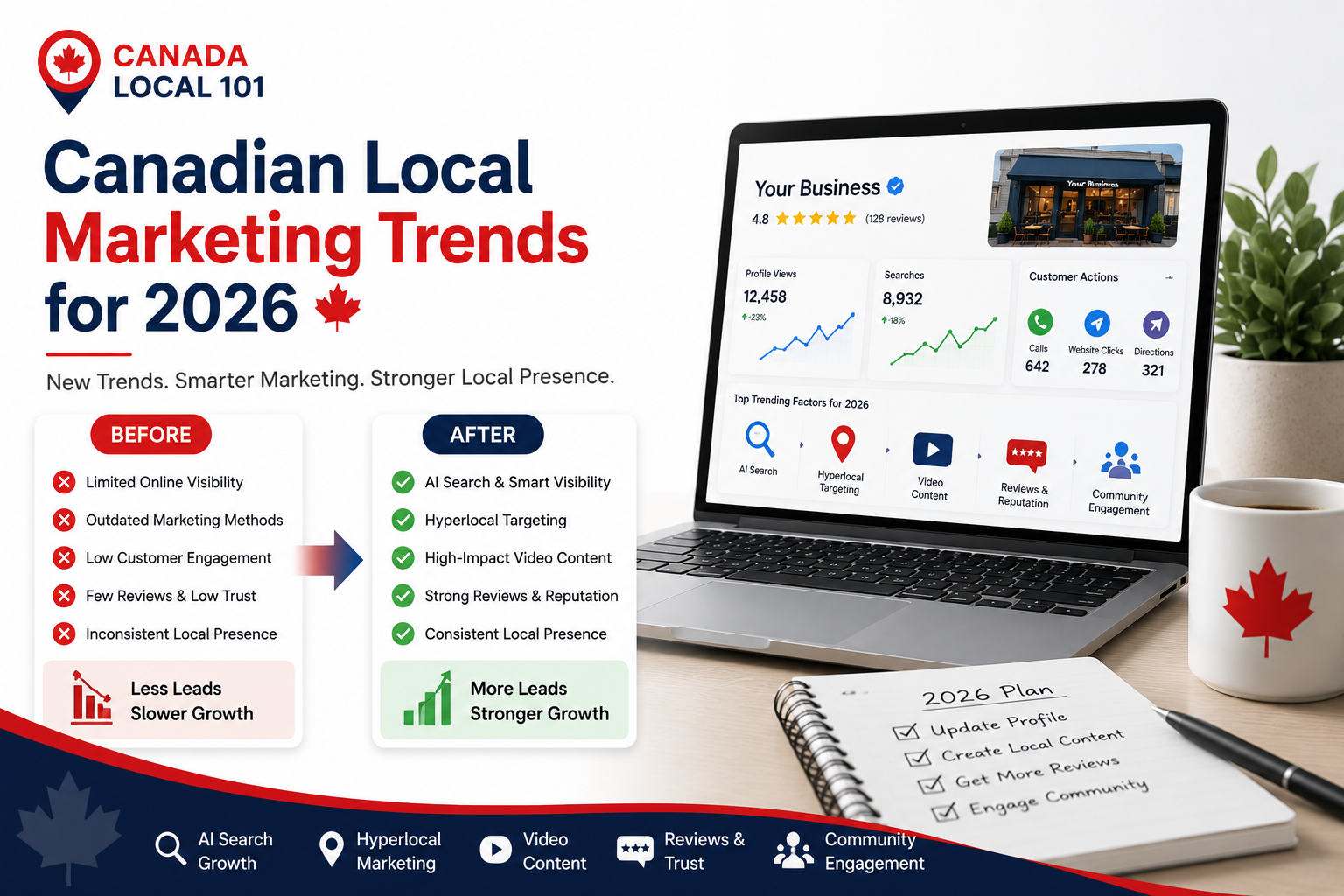
Canadian Local Marketing Trends for 2026
If you’ve followed the same local marketing playbook for the past couple of years, it may be time to re-read it. How people in Canada discover companies, assess them and make their purchasing choices is changing in significant ways that have implications for those looking to grow their business in their region.
It’s not the case of wanting to be on all new platforms or trends. It’s about identifying and investing accordingly in the real market today.
AI Search Is Changing How Canadians Find Local Businesses
This is likely the biggest change that is currently going on. The use of AI-powered search engines is becoming a common way for Canadians to find local services. People are not entering “flooring company Calgary” into Google and reading the pages of search results, they are asking their questions and receiving a summarised response in return.
What This Means for Your Business
AI-generated answers are less likely to appear if the description of a service is vague and only contains three bullet points.
- Content that is clearly written, factually specific and explains your process is more effective.
- The pages which really address customers’ questions are referenced more often than generic pages
- Detail is important. Mentioning your city, your methods, and your process allows the AI to better relate to you.
Companies will find success in AI-powered search when they become able to provide expert-level writing and content that meets the needs of their customers. This has been good practice all along. By 2026 it is rapidly becoming a necessity.
Hyperlocal Targeting Is Getting More Precise
Local targeting is no longer as effective as it once was. When it comes to shopping and hiring, consumers in Canada are getting picky about where and who. The person who lives in Toronto’s Little Portugal doesn’t consider themselves to be a Toronto customer any more than they did five years ago. They want it local and they mean it!
How to Go More Hyperlocal
- Use Google Business Profile service areas to individual neighbourhoods, rather than city.
- Create content that mentions local landmarks, local issues and local community names
- Avoid using city names, but rather use the neighbourhood names in your social media posts
- If you serve multiple districts within a city, talk to each of them individually
A post about a familiar local street, or anything local that has a deeper connection to that neighbourhood, will have a better chance of connecting and getting shared in that area than anything city-wide will ever.
Video Has Moved From Optional to Expected
Over the last few years, short videos have emerged as a standard method for discovering and assessing local businesses, especially for the younger generation (under 45) who now represents a significant portion of the spending power in the local market.
What Works for Canadian Local Businesses on Video
- Clips prior to & after work tasks performed.
- Brief solutions to frequently occurring issues customers have.
- A walkthrough of your process or workspace that is natural.
- Authentic moments from customers, recorded in real-time.
- Short answers to common questions (SAQs)
No need for a production team. Many of the best local business video contents are filmed on a phone, unscripted and are less than one minute. Authenticity is more appealing to Canadians than polish.
Where to Post in Canada Right Now
- Instagram Reels for urban and suburban users.
- TikTok for younger demographics in the major cities in Canada
- YouTube Shorts is designed for content that can be easily found and has a longer shelf life.
- Facebook video for smaller cities, rural Canadian communities where it remains a dominant platform.
Google Business Profile Has Become a Mini Website
Google Business Profile is no longer a listing. It’s often the first and only place a potential customer will check before calling for many local searches in Canada.
How to Use Your GBP Actively in 2026
- Share updates frequently, not necessarily when there’s a big event.
- Add new images of recent jobs every couple of weeks
- Take advantage of the Q and A section to answer the questions customers really ask before calling.
- Ensure your hours, services and contact information are fully up to date at all times.
- Facilitate communication and respond promptly to inquiries
A trend to be noted is the rise in the use of GBP messaging. Google is now the preferred direct service inquiry platform for more Canadians, especially for non-urgent service inquiries, than calling. Rapid action on those messages is increasingly a sign of trust.
First-Party Data Is More Valuable Than Ever
Canada’s privacy laws, such as PIPEDA and the similar provincial laws in Quebec, Alberta, and British Columbia, have made it more strict than ever on how businesses can collect and utilise customer information. Third-party audience data is also less reliable, due to changes in tracking practices by major platforms.
What Canadian Small Businesses Should Be Building
- An email list from your existing customer base with proper consent
- An SMS list to send offers or follow-ups that are time sensitive.
- Loyalty or referral program that can be easily replicated and encourages repeat customers
- Immediate follow-up systems following each task that has been finished.
Creating a simple e-mail list and sending out periodic, helpful and locally relevant information isn’t a novel concept. However, those companies that have consistently done so are in a much better place in 2026 than those that continued to delay it.
Community Involvement Translates Directly to Visibility
One thing that’s important to note in the Canadian market, businesses that are actively involved in their local community are gaining a degree of visibility and word of mouth promotion that paid advertising can’t match.
How Canadian Small Businesses are Establishing a Community Presence
- Sponsoring local hockey teams, community events, or school programs
- Attending farmers’ markets or local business expos
- Chosen a local charity or cause that is meaningful to their customers
- Collaborating with other local businesses on promotions or referrals
- Participating in neighbourhood associations or local business organisations
In Canada particularly, supporting local carries real meaning for consumers. When they feel the company is really part of their community, not just operating within it, they will select it first and they will get it recommended more. That reputation takes time to develop, but it adds up over time, too; that ad spend doesn’t.
Reviews in 2026 Are a Baseline, Not a Differentiator
It’s been a few years since a strong review profile really helped a Canadian small business stand out. In 2026, it approaches the minimum requirement. If there are a few valid, sincere reviews of your business that are recent, you can expect them to give you a second look.
What Canadian Consumers Are Looking at: Beyond the Star Rating
- The recency of the reviews, the older they are, the less their weight will be.
- If the business owner responds and how carefully they do.
- The specific detail in individual reviews, rather than just the score.
- The number of reviews appears to be realistic and consistent over time
Building a Consistent Review System
- Inquire at the end of each task completed
- Provide a link customers can click to find you, rather than them searching.
- Use a QR code on invoices for in-person handovers
- Reply to all reviews, both positive and negative in a couple of days.
- Only use similar responses if they are genuine, not copied and pasted.
A company that has 80 reviews over the past year, and intelligent responses, fares better than a company that has 200 old reviews with no response. Recency and responsiveness are as important as volume.
The Common Thread Running Through All of It
When all of these trends are taken into consideration, the path is pretty obvious. In 2026, customers are expecting brands to have a genuine, local, and trustworthy feel. They have more tools than ever at their disposal to check that out before they call the phone number and they do.
What the Businesses That Will Grow This Year Have in Common
- They are present on the platforms that the customers use consistently
- They are clear about the communities they serve and not generalistic
- They interact with the audience in a sincere manner instead of broadcasting
- Each interaction with a customer is an opportunity to gain the next referral
There is no need for a big budget for any of these. It takes work, commitment, and a sincere interest in your local market customers. That’s what constitutes a local business that continues to thrive despite the shifting platforms and algorithms.
Recent Posts

How Canadian Business Citations Improve Local SEO
Canadian Local Marketing Trends for 2026