
Local Search Trends in Canada: How People Find Businesses Online
Back then, the only way to discover the business you’re looking for locally was to ask someone you knew or flip through a printed directory. Things slowly changed, and then suddenly. The average Canadian accesses their phone first before going to ask a neighbour when looking for assistance, and the entire process from search to decision takes less than two minutes.
What has changed is not only how and where Canadians are searching, but also what they are hoping to find and how fast they are tempted to make their decisions. The ability to comprehend these changes is not an academic exercise for Canadian small businesses. It is the difference between appearing in front of customers who are ready to hire and being completely invisible to them at the exact moment they are looking.
Canada Local 101 was built to serve this evolving search behaviour directly, and the trends shaping how Canadians find businesses online point clearly toward why a structured, locally indexed Canadian directory presence matters more right now than it ever has.
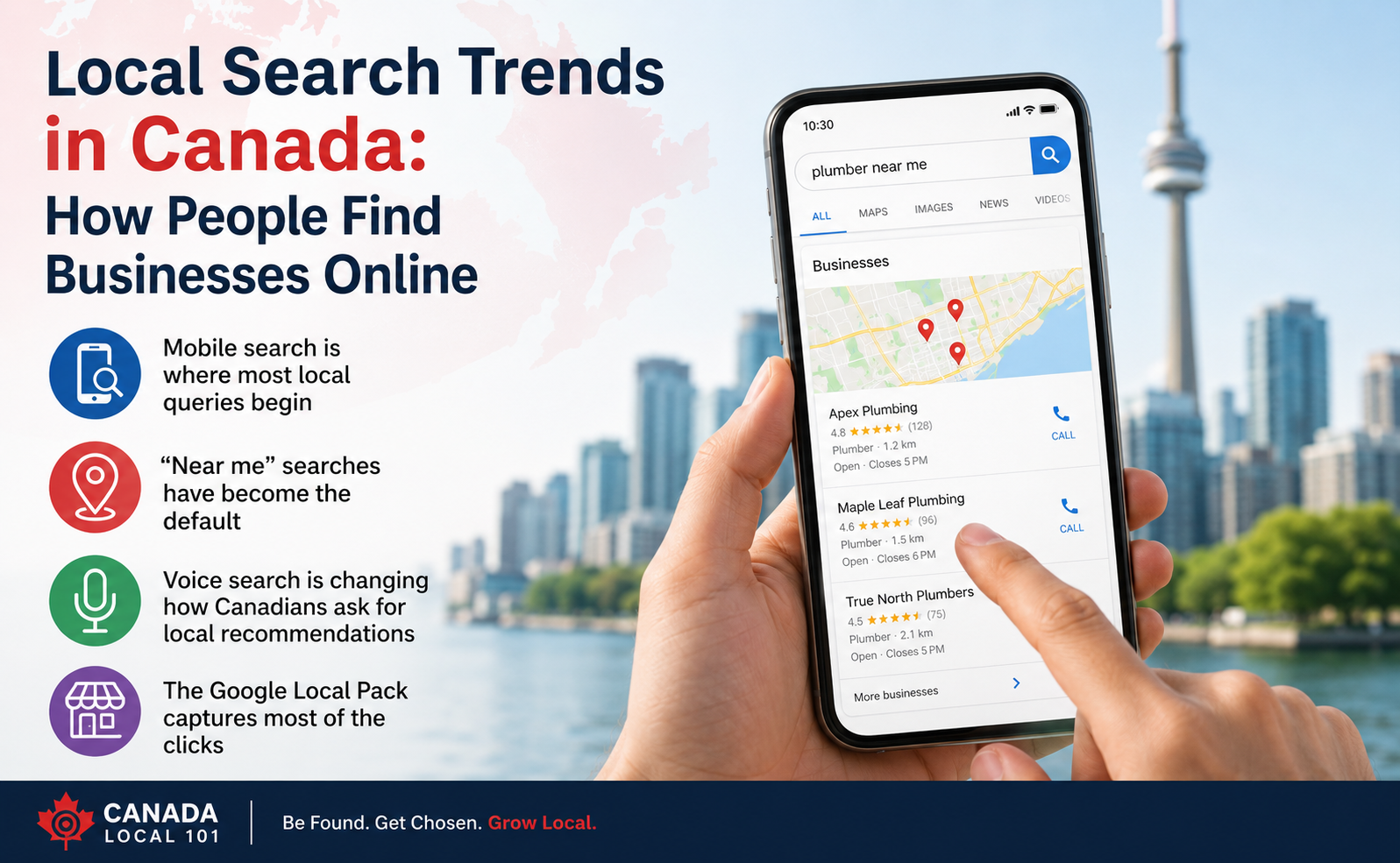
Mobile Search Is Where Most Canadian Local Queries Begin
Most Canadians are searching for local businesses on their mobile devices. This one fact changes the way Canadian businesses must consider their online presence.
This is no casual search by a Canadian who is looking for a plumber on their cell phone while standing in a flooded basement. They are making a decision in just a few seconds based on the information that is directly in front of them. These moments are captured by the businesses that appear in the mobile, local results with the full information, including their services and reviews. Those that are not are missing from the searches that are most important and highest converting within their category on a daily basis.
Mobile search also leads to direct action in a unique way compared to desktop search. When Canadians look up a local business on their cell phone, they’re much more likely to call the business directly from the listing, give directions on the spot, or book immediately. This is why a Canada Local 101 listing with the correct contact information and up-to-date business hours is ideal. If the listing is not complete, the person misses those moments, and they can’t be recovered once the person has called another person.
Near Me Searches Have Become the Default
In Canadian local search, the term “near me” is one of the most popular qualifiers. Geographic intent is now being included in searches for Canadians looking for a restaurant, mechanic, physiotherapist, or cleaning service, for example, either explicitly (e.g., “restaurants near me”) or implicitly (via device location data).
This change has implications for the way local businesses need to market themselves online. “Near me” traffic is a benefit to a business that is geographically established and it appears on credible Canadian platforms such as Canada Local 101, due to the clean, verified and proper location data. A business that provides inconsistent or incomplete location information will be excluded from these results even if it is geographically closest to the “seeker.”
Near me queries receive many thousands of hits daily for every service type in cities with a high density of local ecosystems in Canada such as Toronto, Calgary, Vancouver and Ottawa. The same is true in mid-sized Canadian cities like Kitchener, Kelowna, and St. John’s, where competition for near me results is less, and a well-maintained listing can get considerable attention for relatively little effort.
Outside major urban centres, smaller Canadian communities represent an underserved opportunity. In cities such as Lethbridge, Peterborough or Charlottetown, many local businesses have not added a complete and well-reviewed Canada Local 101 profile and the businesses that have done so successfully often appear at the top of the search result, having very little competition.
Voice Search Is Changing How Canadians Ask for Local Recommendations
Voice search through cell phones, smart speakers and connected devices has been steadily rising in Canadian households, and it works differently from typed search, which makes a difference to local businesses.
A Canadian requests a voice assistant to locate the most effective electrician in his or her neighbourhood or nearest open dental clinic and the assistant provides him/her with one or two choices instead of a page of choices. The algorithm that picks the results is heavily based on structured business data that is stored by directory platforms. These responses rely on clean data (a complete, accurate and well-reviewed Canada Local 101 profile) fed into the systems that power them. If a business does not exist in the directory, it has no way to enter into voice search.
Voice queries also tend to be conversational. Canadians are not typing shorthand into a voice assistant. They are asking complete questions in plain language. Businesses whose listings include natural, descriptive language matching how real customers talk about their needs surface in these responses more reliably than those using technical industry terminology that customers would never actually say out loud.
The Google Local Pack Captures Most of the Clicks
Research consistently shows that the local pack, the map-based block of three businesses appearing at the top of local Google searches, captures the significant majority of clicks in any local search. Organic listings below it receive a fraction of the attention and businesses not appearing in either section get almost none.
Being included in the local pack is one of the most rewarding local digital marketing returns for Canadian small businesses. Some of the key local pack placement signals are the quality of the Google Business Profile, local relevance, proximity to the searcher, and external citation signals from trusted third-party platforms.
A Canadian business that has a fully-featured, consistent listing on Canada Local 101 can directly impact the external citation footprint that Google uses to verify the legitimacy of the business and to decide where to place the local pack. Along with accurate listings on other Canadian platforms and a well-maintained Google Business Profile, this citation consistency plays a key role in your business being visible in the top three listings that receive the majority of local search clicks in your city each day.
Canadians Research More Before Making Contact
Another consistent trend in Canadian local search behaviour is the increase in research conducted before any contact is made. Canadians are not calling the first result they find. They are reading reviews, comparing options, checking photos, verifying hours, and looking at how businesses respond to feedback before picking up the phone.
This means the quality of a Canada Local 101 listing influences lead conversion well before any direct interaction happens. A listing that answers the questions a Canadian consumer asks during their research phase converts a higher percentage of profile views into actual contacts. Businesses treating their directory listing as a passive placeholder lose leads during this research phase to competitors whose listings actively answer these questions.
Here is what strong trust signals look like on a Canadian directory listing right now:
- Genuine reviews with specific details about the work done and the experience of dealing with the business
- The owner responds to both positive and critical feedback that demonstrate professionalism
- Photos showing actual completed work, real staff, or genuine premises rather than stock imagery
- Contact details and hours matching what appears on the business website and Google Business Profile
- A service description written in plain language reflecting how real Canadians search for the service
- Recent reviews showing the business is actively serving customers now, not just historically
Canadian businesses that have built this kind of trust infrastructure are not just appearing in more searches. They are converting those appearances into actual customers at a higher rate because trust is established before the first conversation begins.
Seasonal Search Patterns Are Distinct in Canada
Canadian local search behaviour has seasonal patterns that do not apply the same way in other markets and understanding them helps businesses time their listing activity strategically.
October and November see a dramatic surge in furnace repairs and heating searches in Prairie provinces and Ontario due to the cold weather. Throughout the spring, roofing, eavestrough cleaning, and exterior painting searches ramp up from British Columbia through the Maritimes. Snow removal contractor searches in most Canadian provinces happen in a concentrated window before the first significant snowfall, and businesses that are not visible in that window miss the majority of the season’s opportunities entirely.
A Canada Local 101 listing that is well-maintained and current when these seasonal peaks hit captures the concentrated search volume that comes with them. A listing that is outdated, incomplete, or missing loses those customers to competitors who were ready when the searches started.
What These Trends Mean for Your Business Right Now
All of the trends affecting local search behaviour in Canada lead to a practical conclusion. When your business has correct and complete information, authentic reviews, and a well-maintained profile on the right search platforms across all Canadian cities, it’s able to tap into the search behaviour that’s bringing qualified leads to you every day.
Canada Local 101 is a platform created for Canadian local search, indexed on Canadian communities, and used by Canadian consumers who seek local businesses they can trust. The companies matching their online directory presence with the way Canadians search today are the ones that are converting this trend into a year-round, consistent and growing stream of new business.
Recent Posts

How Canadian Business Citations Improve Local SEO

Canadian Local Marketing Trends for 2026