
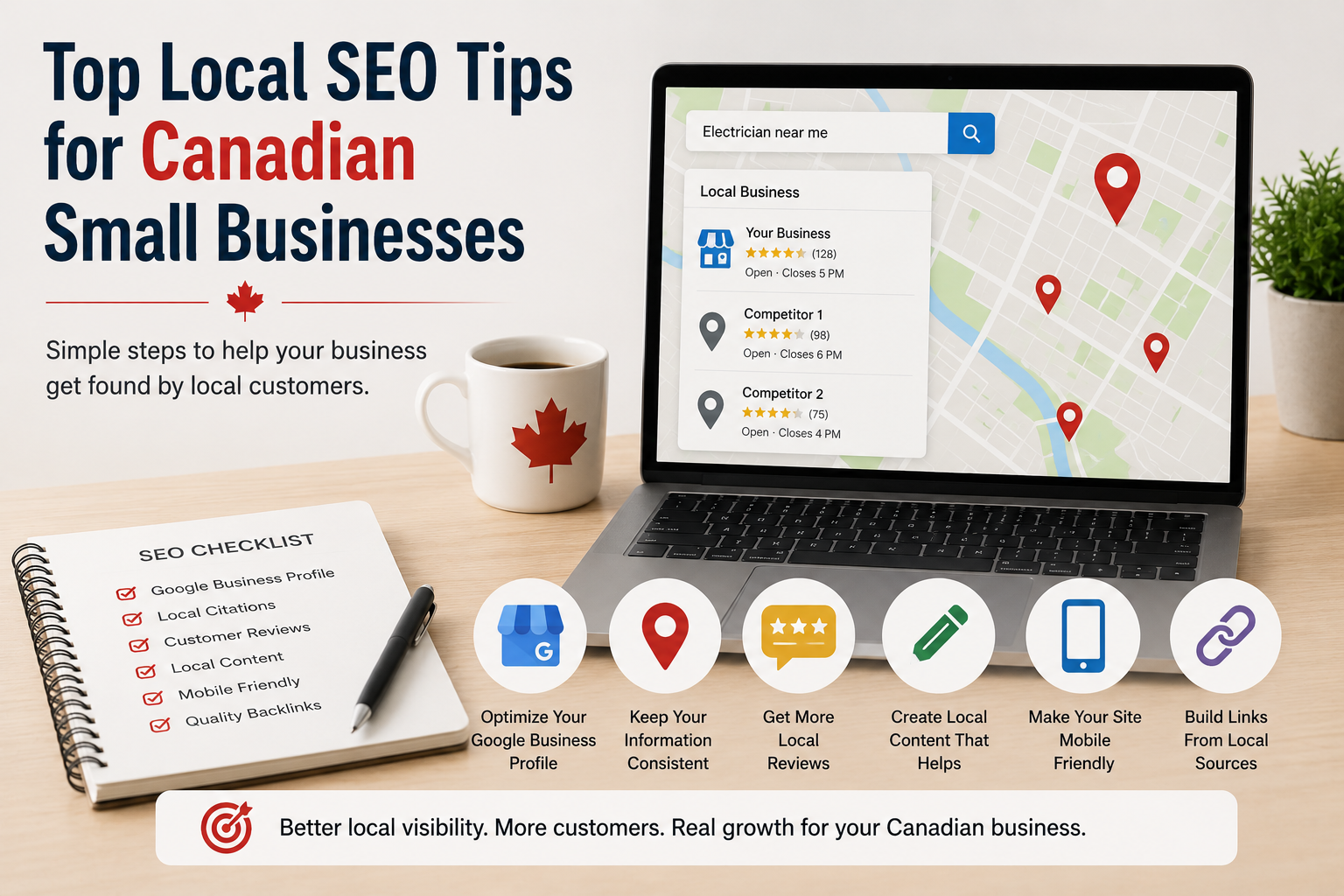
Top Local SEO Tips for Canadian Small Businesses
Being “Discoverable Online” locally is one of the greatest things you can do to grow your small business in Canada! Local SEO, search engine optimization for your geographic location, is the way in which you appear when someone in your city is searching for what you offer.
The positive side is that local SEO doesn’t need to be reserved for enterprises with giant marketing budgets. A small Mississauga business, Calgary, or Halifax business can outrank larger businesses in local search results with the right approach. This guide will help you to navigate the Canadian market without any fluff, practically, clearly and effectively.
Why Local SEO Matters More in Canada
Canada has some unique characteristics that make local SEO especially important for small businesses here.
- Canadian consumers are very location-aware when they search online. Whether it’s people searching for a plumber near them, the best accountant in Edmonton, or even vinyl floor repair in Winnipeg, they are all search queries that occur thousands of times a day throughout the country.
- Proximity, relevance, and trust signals all play a vital role in the results that Google shows for local search, and these factors can be established for a small business with minimal investment.
- For businesses in Quebec and bilingual areas, there is a second chance of being ranked in French-language local results, a market that many businesses do not even bother to optimise.
- Canada’s cities are located in wide geographical areas. There is someone in Kelowna who doesn’t need a Toronto service. It is more effective to target at a local level than to target at a national one.
1. Claim and Fully Optimize Your Google Business Profile
Your Google Business Profile (GBP) is the single most important local SEO asset you have. It manages your business’s presence in Google Maps and the local pack, the three business listings that are displayed at the top of local search results.
Most Canadian small businesses have either not claimed their profile or left it half-filled. This is a chance for you.
A well-structured and optimized GBP will include:
- Business name, Address and Phone Number, which should be the same as what appears on your website.
- The appropriate primary category and the appropriate secondary categories
- A business description that is written with natural local keywords (your city, your service, your neighbourhood).
- Up-to-date, real photos of your premises, team, and work.
- Your business’s hours, including holiday hours
- Answers to all comments, both good and bad
The one thing many Canadian businesses overlook: if you have several cities or regions where you serve, then put the service areas in your GBP. This will increase your local footprint above and beyond where you are registered.
2. Keep Your NAP Consistent Everywhere Online
NAP is an acronym for Name, Address, and Phone Number. Google uses dozens of online directories to cross-reference your business information and determine the trustworthiness and legitimacy of your business. Small typos, such as changing the spelling of “St” to “Street,” create confusion and can negatively impact your local rankings.
The following Canadian directories are important to be added to:
- Google Business Profile
- Yelp Canada
- Yellow Pages Canada (yellowpages.ca)
- Canada411
- BBB Canada
- Bing Places
- Apple Maps
- Your local Chamber of Commerce directory
Review all of them, and ensure that your business name, address and phone number are consistent throughout. It’s not exciting work, but it is the foundation and most of your competition has not done this work the right way.
3. Build Location Pages That Actually Serve the Reader
If you have a business that operates in more than one city or region, then you can’t achieve a good ranking on your single homepage. They require separate location pages for each of the areas they serve, and they must be useful, not a copy of the same location page just with a different city name.
A good location page will respond to questions a local customer would ask:
- What services are provided in that particular city?
- Are there local factors that affect the work? (Climate considerations, building codes, common local materials used, etc.)
- Any reviews or jobs that you’ve finished in that area?
- Where and at what time do you provide services?
If, for instance, a flooring company has offices in both Vancouver and Surrey, they should have separate pages addressing each of these areas, and each page should target the customers in that particular area with relevant and specific information.
Having location pages with duplicated content is worse than having no location pages. Write them correctly or don’t write them.
4. Get Local Reviews and Respond to All of Them
One of the best local ranking factors for Google is reviews. More importantly, they can make a searcher into a customer when they find you.
Reviews are a trusted source for Canadian consumers. The business that has 40 honest reviews with a 4.7 rating will easily beat another business that has 8 reviews with a 5.0 rating, in terms of rankings and click-through rate.
How to build reviews on a regular basis:
- Directly ask each satisfied customer personally, via text, or by e-mail with a direct link to your Google review page
- Make it easy. There is no barrier whatsoever if there’s a QR code on your invoice or a follow-up text message with the link.
- Avoid incentivizing reviews and don’t utilize review gating. Google’s policies prohibit it and it creates trust problems if customers notice
- Reply to all reviews within a few days.. Thank positive reviews specifically; don’t copy and paste the same message; respond to negative reviews in a collegial and professional tone.
A good response to one negative review is more effective in establishing trust than five negative reviews that are poorly managed.
5. Write Local Content That Answers Real Questions
One of the underutilized local SEO tools for Canadian small businesses is your website blog. The more you publish relevant content that addresses actual questions your local customers are asking, the more authority you will build and gain backlinks, keeping your site more active and relevant for Google.
The trick is to write for your targeted audience, and not the general public. A roofing company in Ottawa should be talking about ice dam prevention, how to perform well in freeze-thaw, what materials last and thrive in the winters of Ontario, not some general roofing info that would be applicable to any location.
Blog topic ideas built around local intent:
Blog topic ideas related to local intent:
- “How to prepare your [service] for a Canadian winter”
- The articles, “What homeowners in [City] need to know about [service]”
- Why it is that [local building or climate factor] makes a difference to [your service] here
- “The most common [service] problems we see in [neighbourhood or city]”
Write genuinely. The quality guidelines from Google reward content that has real knowledge and experience, also known as E-E-A-T (Experience, Expertise, Authoritativeness, and Trustworthiness). The more the content conveys real on-the-ground knowledge of your local market, the better it performs.
6. Make Sure Your Website Works Well on Mobile
Over 60% of Canadian searches are conducted on a mobile device. If your site takes a long time to load, is difficult to navigate on a phone, or doesn’t have your phone number easily accessible, you’re losing customers before they even reach out to you.
Check these basics:
- Your website is optimized to load on a cell phone connection in less than 3 seconds.
- Your phone number will be clickable and visible on every page.
- Your address is connected to Google Maps.
- The text is easily readable without zooming in and out.
- The buttons and menus are easily tapable.
Mobile performance is also a direct ranking factor for Google as part of its Core Web Vitals assessment. A slow and cumbersome mobile site isn’t just a bane for the users. It does negatively impact your rankings in search results.
7. Build Links From Local Canadian Sources
One of Google’s most significant ranking factors is still backlinks, which are links from other websites to yours. For local SEO, links from relevant local sites are more important than any other links on the internet.
Where Canadian small businesses can find local connections:
- Local news sites & community blogs about your region
- Your city’s Chamber of Commerce Member Directory
- The network of industry-specific local business associations.
- Host a local event or team and be featured on their webpage.
- Collaborate with other local businesses that complement your service to get cross-referral content.
There is no need to have hundreds of links. Fifty low-quality directory submissions will not have as much of an impact as five or ten high-quality local and relevant links.
Start With the Basics and Build From There
Local SEO for a small business in Canada doesn’t need a large agency or a complex marketing approach. This demands consistency, updating your information, getting genuine reviews, creating helpful local content and ensuring your website is functional.
It’s important to understand that the companies that do well locally are not necessarily the largest or most well-funded. They are the ones who appear regularly, take the web presence seriously and provide Google with clear and trustworthy indications of who they are and where they are serving.
Get your Google Business Profile today. Ensure that your NAP is uniform across directories. Get feedback from your next happy client. Every step produces more results than the previous step, and the effects compound over time.
Recent Posts
How Canadian Business Citations Improve Local SEO

Canadian Local Marketing Trends for 2026